

Early Life
Frank Lloyd Wright was born June 8, 1867, in Richland Center, Wisconsin. (Although he often stated his birthday as June 8, 1869, records prove that he was in fact born in 1867.) His mother, Anna Lloyd Jones, was a teacher from a large Welsh family who had settled in Spring Green, Wisconsin, where Wright later built his famous home, Taliesin. His father, William Carey Wright, was a preacher and a musician. Wright's family moved frequently during his early years, living in Rhode Island, Massachusetts and Iowa before settling in Madison, Wisconsin, when Frank Lloyd Wright was 12 years old. He spent his summers with mother's family in Spring Green. An outdoorsy child, Wright fell deeply in love with the Wisconsin landscape he explored as a boy. "The modeling of the hills, the weaving and fabric that clings to them, the look of it all in tender green or covered with snow or in full glow of summer that bursts into the glorious blaze of autumn," he later reminisced. "I still feel myself as much a part of it as the trees and birds and bees are, and the red barns."
In 1885, the year Wright graduated from public high school in Madison, his parents divorced and his father moved away, never to be heard from again. That year, Wright enrolled at the University of Wisconsin at Madison to study civil engineering; in order to pay his tuition and help support his family, he worked for the dean of the engineering department and assisted the acclaimed architect Joseph Silsbee with the construction of the Unity Chapel. The experience convinced Wright that he wanted to become an architect, and in 1887 he dropped out of school to go to work for Silsbee in Chicago.
Prairie School Architecture
A year later, Wright began an apprenticeship with the Chicago architectural firm of Adler and Sullivan, working directly under Louis Sullivan, the great American architect best known as "the father of skyscrapers." Sullivan, who rejected ornate European styles in favor of a cleaner aesthetic summed up by his maxim "form follows function," had a profound influence on Wright, who would eventually carry to completion Sullivan's dream of defining a uniquely American style of architecture. Wright worked for Sullivan until 1893, when he breached their contract by accepting private commissions to design homes, and the two parted ways.
In 1889, a year after he began working for Louis Sullivan, the 22-year-old Wright married a 19-year-old woman named Catherine Tobin, and they eventually had six children together. Their home in the Oak Park suburb of Chicago, now known as the Frank Lloyd Wright home and studio, is considered his first architectural masterpiece. It was there that Wright established his own architectural practice upon leaving Adler and Sullivan in 1893. That same year, he designed the Winslow House in River Forest, which with its horizontal emphasis and expansive, open interior spaces is the first example of Wright's revolutionary style, later dubbed "organic architecture."
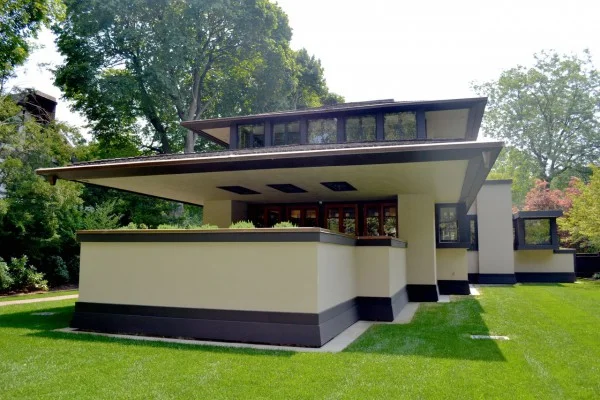
Over the next several years, Wright designed a series of residences and public buildings that became known as the leading examples of the "Prairie School" of architecture. These were single-story homes with low, pitched roofs and long rows of casement windows, employing only locally available materials and wood that was always unstained and unpainted, emphasizing its natural beauty. Wright's most celebrated "Prairie School" buildings include the Robie House in Chicago and the Unity Temple in Oak Park. While such works made Wright a celebrity and his work became the subject of much acclaim in Europe, he remained relatively unknown outside of architectural circles in the United States.